Monday, January 11, 2016

South America (Argentina) - Day 39-40: Tilcara, Purmamarca and the Hornacal

We set off after a meagre breakfast of tea and a solitary stale croissant at the hostel. Our trip from Cachi to Tilcara took us on sealed roads for the most part, stretching out as far as we could see. There were a number of viewpoints along the way for us to enjoy, including the "eye of the condor" which provided dramatic views over the landscape making up Los Cardones national park, taking in Cerro Tin Tin and its multi-coloured formations.

DSC03365.jpg

DSC03371.jpg

P1320864.jpg

P1320865.jpg

P1320874.jpg

Not too long after, things changed as we drove into a massive bank of fog at just over 3000 metres altitude. I could barely see 5 metres ahead of me, and someone had forgotten to fit Big Red with a fog light so it was a lot of fun navigating around a twisting mountain road without being able to see a thing. At this point, Gilly was almost grateful for a lack of driving licence. I was beginning to feel the same. Fortunately, once we crested the peak and started making our way down, the fog gave way to more atmospheric clouds which enhanced the environment rather than blanking it out completely.

DSC03385.jpg

P1320881.jpg

When we were back on more stable ground, we had a couple of encounters with horses and donkeys. One particular donkey saw me as his kind of guy, whilst Gilly tried in vain to make friends with a horse who turned its nose up at a delicious apple core. Argentinian horses: not a fan of leftovers. As we were in need of food ourselves, we stopped at a town called General Martin Miguel de Guemes (a lot of Argentinian places are named after war heroes, revolutionaries, liberators and whatnot), for a milanese in the equivalent of a greasy spoon. Flies were everywhere inside, but the food - essentially a breaded steak - was really good.

DSC03397.jpg

P1320886.jpg

We were about an hour away from Tilcara when we saw a couple of hitchhikers at the side of the road. On our last trip, we'd picked up a guy in New Zealand who had been involved in a pretty bad car accident, and dropped him off at a nearby town. This time, the couple were clearly backpackers and, knowing that Argentina had a reputation for being a popular and safe place to hitchhike, we decided to pull over and pick them up. Their names were Ain and Gonzalo, and they had hitchhiked from Cordoba all the way up to the Salta region. They had a few months off and had never visited the north of the country before, so were really enjoying the beautiful scenery. Ain spoke English, but Gonzalo didn't (or at least, he spoke as much English as I spoke Spanish...pretty much zero), so conversations were a lot of fun. Big Red had a USB slot in the radio, so for our trip we'd been blasting out Ben Folds, Smash Mouth, Def Leppard and Lettuce; far better than the samey music we'd heard on the umpteen radio stations in the area, and our guests appreciated the change too - especially Lettuce. It seems jazz funk is ubiquitous in its popularity.

P1320889.jpg

They were headed to Purmamarca which was about an hour out of our way, but when we told them we were on our way to Tilcara but we'd be visiting Purmamarca, they were happy to stay with us for the ride. We got to Tilcara not long after, having tasted our first cup of mate in the car. Mate (pronounced MAH-tay) is an incredibly popular drink in both Brazil and Argentina - and possibly other South American countries, it remains to be seen - and it's a kind of herbal tea. You fill a small cup with this herb to the top, and then add hot (not boiling) water to it. The cup has a built-in metal straw, and you sip from it until the water is all gone. Then you top it up again. Unlike teabags which are one use only, mate can be used multiple times in the same cup just by pouring water over it. If you go anywhere around Argentina, you'll see people carrying around mate cups and thermos flasks filled with water. I thought the English were obsessive about tea, but these guys take it to another level. After tasting it, I can confirm it's pretty good - like a strong green tea. Not something I'd drink every day, but nice enough.

On arrival in Tilcara, Ain did some translation for us with the local tourist office, and pointed us to Club Hostel Tilcara, where we got a massive family apartment for 350 pesos. They were planning on camping, but in the end decided to find a cheaper hostel around the corner. We wandered around the town which, like a lot of the places in this region, looked like something from the old West, and found ourselves feeling a little chilly for the first time in what seemed like an eternity. Breaking out a fleece at the start of summer seemed odd, but the wind really had a bite. We walked around the market in the main square, and picked up a delicious homemade flatbread filled with ham and cheese from a seller on the street, before catching up with Ain and Gonzalo again. They invited us to their hostel to cook us dinner with wine as a thank you, so we gratefully accepted. Despite the obvious language barrier, Gonzalo and I somehow managed to discuss the merits and drawbacks of both the DC and Marvel universes, and their respective TV incarnations. He wasn't a fan of Jessica Jones, but loved The Flash. Comic book series have a universal language.

P1320893.jpg

P1320894.jpg

P1320902.jpg

Since we were going to Purmamarca the next day, we asked Ain and Gonzalo to tag along if they wanted to, which they did. First though, we wanted to go and see the salt flats a couple hours out from that town. Whilst we didn't expect to experience anywhere near the level of awe we were hoping from the salt flats in Bolivia, we thought that since we were in the area anyway, we might as well go for a drive. And it was quite the drive, taking a road which snaked up the mountain at a considerable ascent. With four people on board and only a 1.4 litre engine, Big Red struggled to get out of second gear for almost the entire way up. We stopped now and again to enjoy the variations in the mountain ranges (the Argentinians were frequently awed by their country, which was lovely to see), and also to snap our first wild llamas. I've no doubt that we'll be sick of llamas when we we eventually leave Peru, but for now they're a novelty. Once we got over the ascent, the drive down was fantastic. Since I could see the road for miles ahead, it was obvious that there was no other traffic coming, which meant I could pelt it down the middle of the road Argentinian-style, and take corners like I was a star in a reasonably priced car. Well, I was in a reasonably priced car.

P1320916.jpg

P1320920.jpg

P1320925.jpg

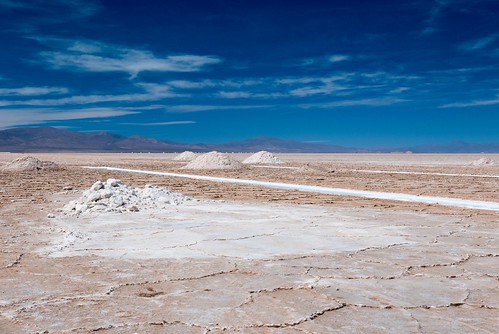
The salt flats themselves were OK. They were a lot less white than I was expecting, but there was an otherworldly nature about the contrasting landscape and the deep blue of the sky which made me feel excited about what we'd see in Bolivia. There are hundreds of trenches cut into the flats which are used to collect salt deposits, and these stretch out for kilometres into the distance. Despite the sun, it wasn't crazily hot which was a relief. We saw a house which had been entirely made out of salt - the bricks, roof and even the furniture inside had been carved out of the local area. When our companions saw that we were taking a mascot around with us, they decided to buy their own: a finger-puppet Ninja Turtle. They chose Leonardo who is clearly inferior to Donatello but each to their own, I guess.
P1320928.jpg

P1320931.jpg

P1320939.jpg

P1320941.jpg

P1320943.jpg

P1320948.jpg

P1320965.jpg

P1320970.jpg

P1320974.jpg

P1320979.jpg

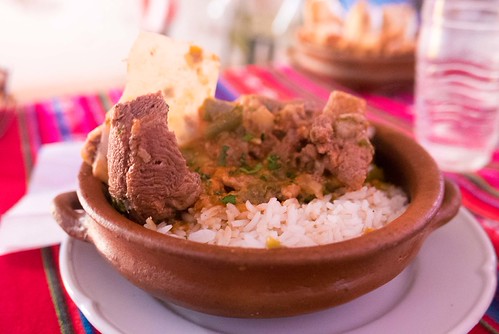
After a trip to a high point in the Jujuy province, Purmamarca was next. The big draw of the town is its seven-coloured hill which is what Ain and Gonzalo were keen to see. First though, we needed food so Ain tracked down a good value local empanada place (Casa del Molles) which also served a llama stew. We ordered a couple between us, and my verdict is: chewy. It was like lamb but without quite as strong a flavour. I have been told that Mr Llama tastes even better as a burger, which I can believe. As for the seven-coloured hill, it lived up to its name even if it wasn't easily accessible and we had to snap it from a distance. Purmamarca was supposed to be a quaint little town, which it was, but it was also dusty and a little too quiet for my liking. I'm glad we didn't decide to stay there, though it was nice to visit.

P1320982.jpg

P1320986.jpg

P1320995.jpg

P1330003.jpg

We drove back to Tilcara where we dropped off Ain and Gonzalo and said our farewells, and they gave us a magnet they'd made as a thank you. They have dozens of them, all unique, each with a photo they have taken. They are selling them as they travel to try and get a bit of spending money to subsidise their trip and some of the photos are fantastic. Hopefully we'll get to see them again some day; travelling is transient by nature, but there's always Facebook to keep in touch.

We arrived in Humahuaca in the afternoon, which is where we planned to stay for a couple of nights. Our lodgings that night were at El Sol Hostel de Humahuaca, where we were clearly the only guests in the entire place, and where the internet was apparently down for the entire town. We didn't hang around too long though, Joe and Lorena from a couple of nights previous had recommended going to the Hornacal. This is a mountain range that allegedly has not seven but fourteen colours, in some sort of geological oneupmanship with its neighbouring town. Another hour's drive along a gravel road, following a pretty sketchy path on our mapping app, and we finally spotted the turn-off. After paying 30 pesos to an old lady who was obviously part of the indigenous tribe in the area for entry onto the land, and we reached our destination. In truth it was far more impressive than Purmamarca's paltry seven colours, but my novice's eye failed to pick out fourteen unless you count slight variations on brown - which the tourist board no doubt do. The sunset on the way back to town was also fantastic, although it distracted me enough to take a wrong turning at one point. Luckily I noticed before we got too far out of our way.

P1330006.jpg

P1330013.jpg

P1330025.jpg

P1330058.jpg

P1330072.jpg

P1330079.jpg

P1330109.jpg

Back in Humahuaca for a chilly walk into the centre, we ended up at El Portillo restaurant and enjoyed a good value menu of the day in kooky surroundings with Norah Jones playing in the background, whilst a cute dog sat under a nearby table. Dogs can come and go as they please in restaurants. If that were the case in the UK, our population would be 48% happier, statistically.

P1330117.jpg

P1330125.jpg

I also noticed that they were offering rooms, so asked to see one and immediately snapped it up for the following night. Right in the centre of town, a much nicer bed, en suite instead of an outhouse bathroom, and more than one plug socket...for only 50p more. Sometimes, reliance on booking through websites means you miss out on gems like this. Thinking about our last trip, we would almost always rock up to a place and then try and find accommodation. It was a pain at times, but we did end up staying in some great guesthouses for very little cost. This time, we are prioritising the security of having a place to sleep, but if a town is small enough it's still worth a mooch around after the first night to see what else is about. We were going to have a proper look around the town the next day, as well as taking a day trip to a neighbouring town called Iruya.

Saturday, January 09, 2016

South America (Argentina) - Day 38: Quilmes and Cachi

Gilly had spotted a site in our guidebook worth visiting from Cafayate; Quilmes. They were an indigenous people who lived in a settlement about an hour south of Cafayate, and resisted the invasion of the Incas in the 15th century. However, the Spaniards eventually overcame them in the mid 17th century and relocated them to a settlement south of Buenos Aires (over 1500km away), causing most of them to die during the journey. Consequently, all that remains are a few descendants of the tribe and the ruins of the original Quilmes people, which was our destination that morning. I've never seen so many cacti in one place.

P1320760.jpg

P1320765.jpg

P1320809.jpg

P1320811.jpg

The ruins are a maze of building foundations zig-zagging their way up the hill for an impressive distance. There are a number of paths you can take to traverse the ruins, either to the left or right of the main settlement, and they all take you up the cliff in an easy-to-follow manner. Before you know it, you're staring down at the remains of an impressive settlement, and wondering what it would look like if the Quilmes people had managed to fend off the Spaniards 350 years ago. The clouds in the distance cast impressive shadows over the landscape. It took us a good couple of hours to traverse one of the paths and there was very little shade from the sun so we decided against the other paths and opted for some cool, cool air-con on our way back up north.

DSC03253.jpg

P1320780.jpg

P1320796.jpg

P1320803.jpg

The road to Cachi was crazy. Not in terms of its bendiness, although it had its fair share of those, but because it was almost all gravel all the way. The car was covered in a white-grey dust before too long, and I'm not entirely sure how we didn't get the paintwork and windscreen scratched from all the flying stones. The views were decent, but not a patch on those we'd seen on the way down from Salta. At one point we almost ran out of petrol, but our reliable MAPS.ME app helped us find a petrol station a mile off the main route in Angastacao, along with some interesting buildings straight out of Tattooine.

P1320824.jpg

P1320831.jpg

We'd booked a room at the Viracocha Art Hostel in Cachi, but when we arrived the owner didn't have any knowledge of the booking. No matter, the room was still available. Hurrah! Except...he couldn't get into the room, because it had somehow locked itself from the inside. He told us that it was going to be another two hours or so before he could get a locksmith out to open it up. Fortunately, Lorena and Joe from Switzerland were also trying to get a place there, and could speak far better Spanish than us, so managed to get the names of a few other places nearby that had rooms which were, you know, accessible. In a stroke of good fortune, we ended up in a double room in Hostal Camino Del Inca for £10 less than we would have paid. Whilst Gilly got ready for dinner, I took a stroll around the town. It was cute enough, but given how much the guidebooks rave about it, there's very little going on - every other shop claims to be an "artesania". Ironically, TripAdvisor reviews suggested that one of the best places to eat in town was at Viracocha (the hostel had a restaurant attached - or vice versa?), so we went back there and I tucked into a steak and potatoes. Good, but not outstanding. So far, Argentinian steak wasn't impressing.

P1320840.jpg

P1320842.jpg

P1320846.jpg

It was better than Joe and Lorena's experience though - it seems that the owner took their order and then completely forgot to inform the kitchen, so they were waiting until 10:30pm to eat. By that time, we were fast asleep and ready for the longest leg of our journey the next day - to Tilcara.

Saturday, January 02, 2016

South America (Argentina) - Day 37: Wine-tasting in Cafayate

In the hostel the previous evening, a Finnish lady had raved about a bodega (cellar) called Piattelli which was about 5km out of Cafayate - she had tried the wine tasting and food there and said they were both excellent. Not ones to pass up such an enthusiastic recommendation, Rollo booked us a taxi at around 10:30 and after travelling down what seemed like miles of gravel road past hundreds of thousands of vines, we arrived at the Piattelli estate...and it was stunning.

P1320624.jpg

P1320626.jpg

P1320634.jpg

P1320637.jpg

P1320639.jpg

P1320648.jpg

The sky was a deep blue, the weather was around 28 degrees with a cool breeze, and the mountain backdrop looked like a matte painting. We joined a tour with a guide whose name shamefully escapes me, and he took us around the three floors of the building to see how the grapes are processed, fermented and ultimately turned into the good stuff. Piattelli opened in 2008 (they also have a bodega in Mendoza which opened in 2005) so by vineyard standards they are pretty young. Their first harvest wasn't until 2012, and the process is precise; leaving grapes for too long before harvesting could burn them, and there's a month-long window between February and March to pick them. Despite seeing the acres and acres of vines, they are all picked by hand at night by workers. No mechanical picking here - it must be a painstaking job. You need around 2kg of grape to make one bottle, hence why so many vines are needed. And because Salta is such a dry region and at altitude, there is pretty much no humidity which means that there's zero fungus, and therefore no need for pesticides.

P1320664.jpg

P1320669.jpg

The speciality of the region is the Torrontes grape, which makes a dry, fruity and fairly light white wine. It smells amazing and tastes almost as good. But when we hit the actual tasting, as well as the whites we also got to try a number of Malbecs, including a Malbec-Tannat blend which was fantastic. At least, until our host broke open the grand reserve varietal which knocked the socks off all the reds we'd previously tasted. My tasting notes, albeit seven glasses in, read "OMFG", so I'm pretty sure I loved it. There were a couple of dubious wines: one was Rose of Malbec, a rosé which felt oaky, harsh and a little too strong, whilst the Cafayate Malbec tasted leathery and smelt like gas compared to its much nicer Mendoza counterpart. Out of the two Cabernet Sauvignons we tried, the Cafayate trumped Mendoza hands down.

P1320680.jpg

The delights of Piattelli didn't end there, as all of the wine tasting had given us an appetite. We took a seat on the terrace facing the wonderful landscape and after deciding against the tasting menu we instead went for two starters, a main and a dessert to share between us along with a glass of the grand reserve which we'd now acquired a taste for. The chicken salad was delicious - the meat had been marinated in some sort of Cajun sauce and the dressing of the salad made it enjoyable even to me, a known salad sceptic. The steak and pitas were equally flawless, whilst the pork bondiola was perfectly nice but not quite on a par with the starters; this was addressed in the trio of desserts, which included a wine sorbet. Magnificent. In short, this was the best food we'd eaten since arriving on the continent, and whilst it wasn't a friend of the budget traveller, at £35 total for the pair of us it put the majority of UK restaurants to shame.

P1320696.jpg

P1320715.jpg

P1320707.jpg

P1320710.jpg

P1320711.jpg

P1320719.jpg

The day was still young, so we got the taxi to drop us off at Vasija Secreta en route to the hostel. This was a much older bodega which had gone through multiple name changes over the years. The wine-tasting here was free, although we only got to try a white and a red. Neither were outstanding, but they were perfectly drinkable. The bodega houses a museum of sorts, but it can be wandered around in about five minutes. A walk back to town in intense heat saw us pass an abandoned shop with carvings of llamas and birds outside. I suspect it may have been a defunct tourist trap, but it looked abandoned.

P1320726.jpg

P1320737.jpg

P1320744.jpg

As all good things come in threes, we decided to try one more bodega at the suggestion of Rollo: Domingo Hermanos. This was superb - for 10 pesos (50p) each, we got to try two whites, two reds and a sweet wine along with cheese. At this point my recollection of their quality is a little fuzzy but I don't recall there being a duff glass amongst them.

P1320747.jpg


We rounded off the evening at La Casa de las Empanadas, an empanada joint run with fierce efficiency by a lady who clearly knew her stuff. All of the empanadas (of which there were at least fourteen flavours) were made to order and came with a spicy sauce. We could only manage two each, but they were just the right size to fill us up for dinner, and we got to leave our names on the wall along with the thousands of others who had come before us.

P1320753.jpg

A stroll back to the hostel via the quiet streets took in a cloudy moon. Cafayate is a sleepy little town, but I adored it. If I could have stayed another two or three days I could have quite happily wandered between the umpteen bodegas in the area, but as it was I felt lucky to have discovered a place a little different to the bustling cities and tourist towns, as well as some new wines to source on our return.

P1320754.jpg

Our road trip was to continue the next day to Cachi, with a morning detour to Quilmes to look at the remnants of an old civilisation.